Tuesday, February 14, 2012
Genome: Chromosome 1 - Life
In this chapter, life began with a single word: DNA. Life consists of two different skills, the ability to replicate and the ability to create order. The key to both of these is information. Information is the instructions for building and maintaining the equipment that creates order. The author relates genes to coded recipes, with its four repeated letters A, T, C, and G. A gene has 120 different letters that are constantly being copied into a short filament of RNA, the copy being called 5SRNA. The genes are able to replicate because of proteins. The author mentions how RNA may have came before proteins because RNA is a chemical substance that links DNA and proteins together; therefore, RNA must have come before. Ultimately, genes are the same everywhere, in all organisms and life. Their genetic code are the same and wherever we go and whatever organism we see, they will have the same codes and languages.

Sunday, February 5, 2012
Genome: Introduction
The introduction chapter basically talked about the twenty-three chromosomes of the human genes. Each of the twenty-two pairs of chromosomes are numbered based on their size whereas the last pair of chromosomes contained the sex chromosomes. Matt Ridley had compared the human genome to a book which I thought had made it easier to learn about the genome. He stated that the twenty-three chapters are chromosomes, each chapter with several thousand stories are the genes, each story that is made up of each paragraphs is the exons, each paragraph with words that are called the codons, and each letters is the bases.This introduction chapter also talks about how the genes can undergo replication and translation, how replication involves the four letters A,C,G, and T, and translation which involves RNA, replacing T for U. The rest of the chapter talks about how everything is made of proteins that is later on translated into a gene.
Extra Credit Blog: Reflection on First Semester
What topics really confused you?
I am still confused on the chemistry, cell, and bacteria chapters.
What topics do you feel very clear on?
I feel the best with the ecology chapters compared to all the chapters. All the other chapters, I feel like I don’t know it completely.
What lab/ activity was your favorite? Why?
Some of my favorite activities were when we planted our seeds into the jar. It was amazing to watch how my plant grew compared to everyone else’s plants. For the chromatography lab, it was interesting watching how the solvent gradually moved up the filter papers. As for the flower dissection activity, I liked being able to look through microscopes and be able to see the pollen clearly. I also liked being able to realize that our school had a lot of plant diversity when we explored our campus looking for different insects and flowers.
What lab/activity was your least favorite? Why?
My least favorite lab would be the fly lab because it felt tedious to cross each trait, yet I witnessed many flies with different traits that seemed interesting to me. My other least favorite lab would be the bacteria lab because I did not want to inhale or get any dye on my clothing. Knowing what problems could arise if I had inhaled anything made me afraid to be near the bacteria when opening it.
If you could change something about the class to make it better, for instance the type of homework (not the amount) what would it be and why?
Sometimes I don’t know which reading quizzes I need to complete and which blogs I have to finish. When we had a list of blogs to do, it made finishing the blogs so much easier knowing which ones I had to do.
I am still confused on the chemistry, cell, and bacteria chapters.
What topics do you feel very clear on?
I feel the best with the ecology chapters compared to all the chapters. All the other chapters, I feel like I don’t know it completely.
What lab/ activity was your favorite? Why?
Some of my favorite activities were when we planted our seeds into the jar. It was amazing to watch how my plant grew compared to everyone else’s plants. For the chromatography lab, it was interesting watching how the solvent gradually moved up the filter papers. As for the flower dissection activity, I liked being able to look through microscopes and be able to see the pollen clearly. I also liked being able to realize that our school had a lot of plant diversity when we explored our campus looking for different insects and flowers.
What lab/activity was your least favorite? Why?
My least favorite lab would be the fly lab because it felt tedious to cross each trait, yet I witnessed many flies with different traits that seemed interesting to me. My other least favorite lab would be the bacteria lab because I did not want to inhale or get any dye on my clothing. Knowing what problems could arise if I had inhaled anything made me afraid to be near the bacteria when opening it.
If you could change something about the class to make it better, for instance the type of homework (not the amount) what would it be and why?
Sometimes I don’t know which reading quizzes I need to complete and which blogs I have to finish. When we had a list of blogs to do, it made finishing the blogs so much easier knowing which ones I had to do.
Saturday, January 21, 2012
Major Plant Divisions
Charophyceans
Charophyceans are the green algae that are most closely related to plants. They have cell walls that are made of cellulose and have the presence of chlorophylls a and b within the chloroplasts. Charophyceans are equipped with rose-shaped arrays of proteins that synthesize the cellulose microfibrils of the cell walls. They also have peroxisomes that make them closely related to land plants. They have flagellated sperm cells and are involved in the cell division formation of phragmoplast.

Bryophytes
Bryophytes have three separate phyla: liverworts, hornworts, and mosses. Mosses are the most familiar in bryophytes. It is a nonvascular plant with gametophyte being the dominate generation in their life cycles. The lack conducting tissues that help them distribute water and organic compounds within their thick tissues. Because they do not have lignified vascular tissues, their growth height is limited. These plants are common in moist alpine, boreal temperate, tropical forests and wetlands.

Pteridophytes
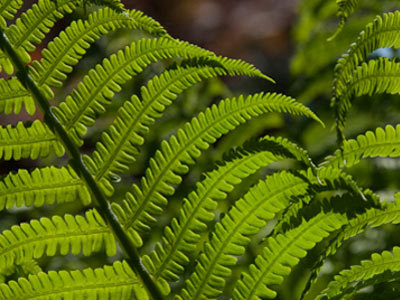
Pteridophytes are seedless vascular plants and have roots with lignified vascular tissue. Because their vascular system resembles earlier vascular plants, this suggests that their roots evolved from the subterranean portions of stems of ancient vascular plants. There are two phyla involved: Lycophyta and Pterophyta (ferns, whisk ferns, horsetails). For reproduction, sporophyte dominates its life cycle. Megaspores develop into female gametophytes bearing archegonia while microspores develop into male gametophytes with antheridia. Water ferns are the only heterosporous species. Because of their swimming sperm and fragile gametophytes, pteridophytes are most common in relatively damp habitats.

Gymnosperms
Gymnosperms lack enclosed chambers, also known as ovaries, where angiosperm ovules and seeds develop. Another name for gymnosperms is the naked seed. These seed bearing plants include conifers, pines, ginkos, and cycads. Most conifers are evergreens, retaining their leaves throughout the year. They are adapted to dry conditions and are amongst the largest and oldest organisms on Earth. Conifers are heterosporous. Both male and female gametophytes develop from different types of spores by separate cones. If a seed lands in a habitable place and beings to germinate, then the embryo emerges as a pine seedling.

Angiosperms
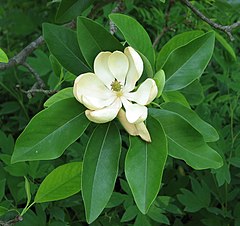
Angiosperms are also known as flowering plants. Angiosperms are vascular plants with seeds. They are divided into two main classes which differ in anatomical and morphological details: the monocots and the dicots. The flower in the angiosperm structure is specialized for reproduction and includes four circles of modified leaves: sepals, petals, stamens, and carpels. After reproduction, the fruit is a mature ovary which the seeds of the angiosperm are dispersed by wind or animals. They are involved in coevolution where the pollinator-plant relationship is cause of the diversity of flowers. They play an important role in terrestrial ecosystems because animals pollinate the flowers while animals other animals transport the seeds to new and different locations. Angiosperms play an important role in agriculture because if provides nearly all our food. All our fruit and vegetable crops are angiosperms.

Source: Campbell book
Charophyceans are the green algae that are most closely related to plants. They have cell walls that are made of cellulose and have the presence of chlorophylls a and b within the chloroplasts. Charophyceans are equipped with rose-shaped arrays of proteins that synthesize the cellulose microfibrils of the cell walls. They also have peroxisomes that make them closely related to land plants. They have flagellated sperm cells and are involved in the cell division formation of phragmoplast.
Bryophytes
Bryophytes have three separate phyla: liverworts, hornworts, and mosses. Mosses are the most familiar in bryophytes. It is a nonvascular plant with gametophyte being the dominate generation in their life cycles. The lack conducting tissues that help them distribute water and organic compounds within their thick tissues. Because they do not have lignified vascular tissues, their growth height is limited. These plants are common in moist alpine, boreal temperate, tropical forests and wetlands.

Pteridophytes
Pteridophytes are seedless vascular plants and have roots with lignified vascular tissue. Because their vascular system resembles earlier vascular plants, this suggests that their roots evolved from the subterranean portions of stems of ancient vascular plants. There are two phyla involved: Lycophyta and Pterophyta (ferns, whisk ferns, horsetails). For reproduction, sporophyte dominates its life cycle. Megaspores develop into female gametophytes bearing archegonia while microspores develop into male gametophytes with antheridia. Water ferns are the only heterosporous species. Because of their swimming sperm and fragile gametophytes, pteridophytes are most common in relatively damp habitats.
Gymnosperms
Gymnosperms lack enclosed chambers, also known as ovaries, where angiosperm ovules and seeds develop. Another name for gymnosperms is the naked seed. These seed bearing plants include conifers, pines, ginkos, and cycads. Most conifers are evergreens, retaining their leaves throughout the year. They are adapted to dry conditions and are amongst the largest and oldest organisms on Earth. Conifers are heterosporous. Both male and female gametophytes develop from different types of spores by separate cones. If a seed lands in a habitable place and beings to germinate, then the embryo emerges as a pine seedling.

Angiosperms
Angiosperms are also known as flowering plants. Angiosperms are vascular plants with seeds. They are divided into two main classes which differ in anatomical and morphological details: the monocots and the dicots. The flower in the angiosperm structure is specialized for reproduction and includes four circles of modified leaves: sepals, petals, stamens, and carpels. After reproduction, the fruit is a mature ovary which the seeds of the angiosperm are dispersed by wind or animals. They are involved in coevolution where the pollinator-plant relationship is cause of the diversity of flowers. They play an important role in terrestrial ecosystems because animals pollinate the flowers while animals other animals transport the seeds to new and different locations. Angiosperms play an important role in agriculture because if provides nearly all our food. All our fruit and vegetable crops are angiosperms.
Source: Campbell book
Extreme Organism
One extremophile is the tardigrades, also known as waterbears or moss piglets. It is part of the superphylum Ecdysozoa. They have eight legs and are microscopic. Tardigrades can be found in lichens and mosses, dunes, beaches, soil, marine or freshwater sediments, or a soaking piece of moss in spring water. Tardigrades are considered an extreme organism because they are available to survive in environments that would kill other organisms. They feed on the fluids of plants and animal cells. For a tardigrade’s life span, if it never go into a dormant state, then they only live for less than a year, whereas if they do go into dormant state, they can live up to 60 years. As for reproduction, they are oviparous and fertilization is usually external. The eggs hatch no later than fourteen days and the organism hatched already possess its adult cells. They can survive in temperatures near −273 °C (−459 °F) and 151 °C (304 °F). This temperature range has 1,000 times more radiation than other animals would absorb. They can also survive in very low and very high pressure and survive in nearly ten years of dehydration.

Source: http://www.iwu.edu/~tardisdp/tardigrade_facts.html

Source: http://www.iwu.edu/~tardisdp/tardigrade_facts.html
Cell Poem
Dear cell,
all eukaryotic cell
all prokaryotic cell
you all make me so well because you do not smell.
The nucleus,
you hold the DNA and the genes,
making me want to take a tour of your cell on a bus.
Ribosomes
producing proteins is what they do
you make me want to go to the zoo.
Golgi apparatus, cis and trans,
feels like sorting shoes from boots to laces to vans.
Endoplasmic reticulum, so smooth and rough
are you considered tough and buff?
Dear cell membrane,
includes the integral proteins which penetrates the lipid bilayer
and the peripheral proteins which are not embedded in the lipid bilayer.
please be permeable and let substances pass through you without a hassle,
needing transport protein, carrier proteins, channel proteins.
Protecting the cell is your role.
Dear cell signaling,
signal transduction pathway is a multistep process for cellular response
local regular and hormones brings organisms together
ligands bind from small molecules to big molecules.
reception, transduction, and response are the stages to cell signaling.
Cell signaling is vital to the cell’s communication process.
all eukaryotic cell
all prokaryotic cell
you all make me so well because you do not smell.
The nucleus,
you hold the DNA and the genes,
making me want to take a tour of your cell on a bus.
Ribosomes
producing proteins is what they do
you make me want to go to the zoo.
Golgi apparatus, cis and trans,
feels like sorting shoes from boots to laces to vans.
Endoplasmic reticulum, so smooth and rough
are you considered tough and buff?
Dear cell membrane,
includes the integral proteins which penetrates the lipid bilayer
and the peripheral proteins which are not embedded in the lipid bilayer.
please be permeable and let substances pass through you without a hassle,
needing transport protein, carrier proteins, channel proteins.
Protecting the cell is your role.
Dear cell signaling,
signal transduction pathway is a multistep process for cellular response
local regular and hormones brings organisms together
ligands bind from small molecules to big molecules.
reception, transduction, and response are the stages to cell signaling.
Cell signaling is vital to the cell’s communication process.
Three Key Ideas for Time, Love, Memory
In Quinn’s experiment, he put mutant flies into a countercurrent machine with two smells: octanol which is relatively bad, and methylcyclohexanol which is relatively good. When the flies went toward the light with octanol, Quinn gave them a chock. When the flies went toward the light with methylcyclohexanol, he did not give them a shock. After a couple of repeated experiments in a new test tube, Quinn concluded that the flies were learning from their own experience. This is similar to what we have learned in the animal behavior chapters. This experiment is related to a taxis or kinesis movement where organisms learn from repeated mistakes or experiments. The flies have learned after countless of experiments to move away from the light in an octanol environment and move toward the methlcyclohexanol environment.
As mentioned in the book, Time, Love, Memory, flies tend to form chains with each other. On pg. 126, it states that if there is good food and a nice warm constant temperature, it encourages the flies to start chaining. Food is rather important to these flies. This relates to what we are learning because all organisms require an adequate amount of food, a good temperature range, and a good social environment that helps flies become more active and therefore, allowing them to reproduce.
Throughout this book, clocks have been mentioned several times about having specific timings which they function. Clocks control the rhythmic behavior of life. This relates to photosynthesis. Just like how in photosynthesis, C3, C4 and CAM plants, some of these plants function at nighttime whereas some work during the daylight. CAM plants open their stomata at night and close them during the day, the reverse way of when other plants open their stomata during daylight. It is also similar as to when we humans have clocks in our bodies, requiring us to wake up, eat our three daily meals, and sleep around the same specific times.
As mentioned in the book, Time, Love, Memory, flies tend to form chains with each other. On pg. 126, it states that if there is good food and a nice warm constant temperature, it encourages the flies to start chaining. Food is rather important to these flies. This relates to what we are learning because all organisms require an adequate amount of food, a good temperature range, and a good social environment that helps flies become more active and therefore, allowing them to reproduce.
Throughout this book, clocks have been mentioned several times about having specific timings which they function. Clocks control the rhythmic behavior of life. This relates to photosynthesis. Just like how in photosynthesis, C3, C4 and CAM plants, some of these plants function at nighttime whereas some work during the daylight. CAM plants open their stomata at night and close them during the day, the reverse way of when other plants open their stomata during daylight. It is also similar as to when we humans have clocks in our bodies, requiring us to wake up, eat our three daily meals, and sleep around the same specific times.
Subscribe to:
Posts (Atom)