Saturday, January 21, 2012
Article: On Societies as Organisms
In this article, the author mainly talks about how although organisms are separate individuals, but when combined, they become one big entire organism. One big example is the ant. If they are wandering individually, they are small creatures. When they are all crowding around one similar area, then you can begin to see “the whole beast”. Termites and bees are also described similarly to the ants. Bees distribute themselves equally to work efficiently for the queen. “The phenomenon of separate animals joining up to form an organism is not unique to insects.” This means that most organisms have worked together to accomplish tasks before, and joining up is considered normal. As for humans, although we are one human being, we are all linked together for information. I agree with this article because each and every one of us are all separate humans and organisms, but at some point, we always work together during our lifetime.

Article: Thoughts for a Countdown
This article talks about how humans from another plant will view other organisms from another plant as something that shouldn’t be reconciled with. In the beginning of this article, when astronauts arrive at the moon, they wear surgical masks, meaning that they do not want to touch anything with their bare hands because they do not know what life is on the moon. If there is really life on the moon, then we “must begin by fearing it. We must guard against it.” We live with other living things in harmony. Other than organisms, we humans also exhibit symbiotic relationships. “Every creature is connected to and dependent on the rest.” It means that we all need each other. Microbes and bacteria have been said to collaborate, accommodate, exchange, and barter with each other. For example, all organisms have their own way for survival and what they do for a living. Anemones can recognize molecular configurations while crabs can recognize their own anemone. In the end of the article, Theodor says, “if same species are placed in close contact, the smaller of the two will always begin to disintegrate.” Theodor is saying that those two organisms have the same niche they need in order to survive. They will compete for it, perhaps overpowering the other party, causing the other party to start being extinct and disintegrate. I agree with this article because people will also fight for what they want because they will be able to live and survive better with it. Humans are also putting on gloves and wearing masks as they walk outdoors because they do not want to be contaminated with others’ germs.
Article: The Lives of a Cell
This article mainly focuses on how each individual and organism on this plant is interlocked with each other. In the beginning, the article states that the man is similar to “a lethal force whereas the earth is pictured as something delicate”, overall resulting to the idea that man is embedded within nature. The article says that “we are shared, rented, occupied”. There are organelles in our bodies that are driving our every day movements, and these organelles are not strictly ours. For example, the mitochondria, centrioles, basal bodies, and other organelles work inside our bodies, each with its own special genome. We should believe that these organelles are functioning for our own benefits, but it may be that the organelles are the reason why we are doing movements that we are doing now. It is similar to an example in the article, where green plants cannot be plants or be green without their chloroplast for photosynthesis; these chloroplasts are separate creatures within their own genomes. Overall, the man feels that there is differentiation and speciation, but does not feel separate at all. I agree with his man’s feelings because I believe that all the organelles inside our bodies function as one unit, each relating and leading to one another. We are connected to our inner bodies and how they function and what their outcome is depends on us and the interior of our cells.
Wednesday, January 11, 2012
Lit. Circle Book: Time, Love, Memory
In Time, Love, Memory, what surprised me the most was the experiment on how mutant fruit flies tend to move toward the light rather than the dark. Ever since Chapter 1, the experiment created by Seymour Benzer has reappeared in almost every chapter. In Benzer’s experiment, he connected two test tubes and put them mouth to mouth. He put one end of the test tube under the light while the other end of the test tube was in the darkness. He would make sure that the test tubes were still and tap the glass in order for the flies to start their movements. After countless of experiments, Benzer concluded that most of the flies moved toward the light. From my observations, the flies in my room like to fly in both dark and light environments. Although fruit flies are different from normal flies, I never thought about how the flies move. Benzer’s experiment was one of the most interesting and surprising experiments to me because I never thought about observing what the flies’ movements were like.


Source: Time, Love, Memory by Jonathan Weiner

Source: Time, Love, Memory by Jonathan Weiner
Tuesday, January 10, 2012
Article: A Fear of Pheromones
In the article, “A Fear of Pheromones,” animals are not the only organisms that can release odors; humans can as well. Some chemical odors can either confuse or attract other organisms to each other. After reading through the ecology chapters, chemical odors are sometimes used to tell other organisms around the same vicinity a warning that predators are near and to find safety quickly. According to this article, pheromones are small, simple molecules that are active in extremely small concentrations. A neighboring territory could possibly smell the scent of the odor and react to it quickly. The odors can also have a “fragrance of ambiguity”. An example is the female moth; if it releases bombykol, that single molecule can tremble the hairs of any males relatively far within miles, causing that male to become confused. Another example is when the female monkeys respond to the estradiol released by the male primates. Other than causing the organisms to become confused, pheromones can help organisms identify what type of species the organisms is. An example is that fishes make use of chemical signals for identifying individual members of a species and announcing the changes in the statuses of certain individuals. Although there is not much information about humans being involved with pheromones until recently, I agree with this article because it states important key facts. I believe that humans can communicate and react with each other based on their pheromones. Just like the example given in the article where the dog is able to sniff out their owner shows that we humans release a scent which allows the animals to recognize their owner. In our world, there are females who sprays an excessive amount of perfume on and males who sprays axe on themselves. The scent disperses and individuals near the person may tend to walk away because the scent is so strong that it is unbearable, or walk towards it because the scent is fragrant.
Friday, January 6, 2012
Virtual Diffusion Lab

In order for the cell to have the highest rate of diffusion, the cell must have:
Surface area: 986.25
Volume: 4.25
Surface area/volume ratio: 232.13
Villi: 20%
Radius: 1X
Cell shape: 10:1
Number of dimples: 0
Dimple % of cell surface area: 10
Source: http://www.mhhe.com/biosci/genbio/biolink/j_explorations/ch02expl.htm
Wednesday, January 4, 2012
Exemplars of Each Phyla of Protozoa
Diplomonadida
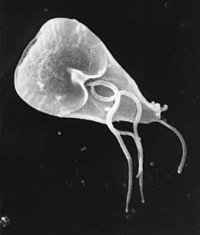
Giardia lamblia is an anaerobic parasite that colonizes and reproduces in the small intestine. It causes abdominal cramps and severe diarrhea. People pick up Giardia by drinking water that is contaminated with human feces.

Parabasala
Trichomonas vaginalis inhabits a female's vagina. It has both flagella and an undulating membrane. These structures allow the protist to move within the reproductive and urinary tracts of it's host.

Euglenozoa
Kinetoplastids has a large mitochondria with an organelle called the kinetoplast. The kinetoplast holds extranuclear DNA. The kinetoplastid are symbiotic and pathogenic to their hosts.

Alveolata
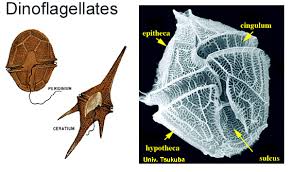
Dinoflagellates are abundant in aquatic pastures of phytoplankton near the water surface. Most are unicellar, having a shape reinforced by internal plates of cellulose. When they bloom, they cause red tides in coastal waters. Toxins produced have killed fish and invertebrates, which can also be deadly to humans as well.
Apicomplexans are parasites of animals. These parasites can disseminate as tiny infectious cells called sporozoites. The sporozoites contain specialized organelles for penetrating host cells and tissues. They have a complex life cycle, usually involving two or more host cells.

Stramenopila
Diatoms have unique glasslike walls, with each wall overlapping each other. They reproduce asexually by mitotic cell divisions. Both freshwater and marine plankton are rich in diatoms. These diatoms store food reserves in the form of a glucose polymer called the laminarin.

Golden algae are biflagellated with both flagella attached near the end of the cell. They are mixotrophic and unicellular.

Rhodophyta
Red algae lack flagella and are adapted to different water depths. The red algae is the most abundant large algae in the warm coastal waters of tropical oceans. They are multicellular, and also similar to the seaweed brown algae.

Chlorophyta
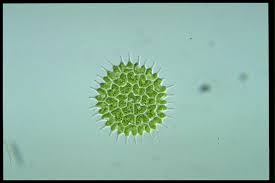
Green algae are named for their chloroplasts. Their common ancestors might have chloroplasts from cyanobacteria. They are closely related to land plants. Most chlorophytes live in plankton or inhabit damp soil or snow while some live symbiotically with other eukaryotes. They also live symbiotically with lichens.
Mycetozoa
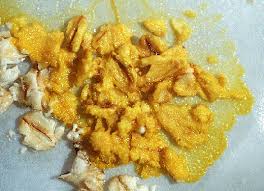
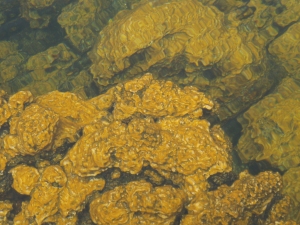
Plasmodial slime molds are brightly yellow or orange pigment. They are heterotrophic with a feeding stage called the plasmodium which contains many nuclei. The plasmodium engulfs food particles by phagocytosis.
Cellular slime mold contains cells that maintain their identity and remain separated by their membranes. They are haploid organisms which have fruiting bodies that function in asexual reproduction. They have no flagellated stage.
Source: Campbell book
Giardia lamblia is an anaerobic parasite that colonizes and reproduces in the small intestine. It causes abdominal cramps and severe diarrhea. People pick up Giardia by drinking water that is contaminated with human feces.
Parabasala
Trichomonas vaginalis inhabits a female's vagina. It has both flagella and an undulating membrane. These structures allow the protist to move within the reproductive and urinary tracts of it's host.

Euglenozoa
Kinetoplastids has a large mitochondria with an organelle called the kinetoplast. The kinetoplast holds extranuclear DNA. The kinetoplastid are symbiotic and pathogenic to their hosts.

Alveolata
Dinoflagellates are abundant in aquatic pastures of phytoplankton near the water surface. Most are unicellar, having a shape reinforced by internal plates of cellulose. When they bloom, they cause red tides in coastal waters. Toxins produced have killed fish and invertebrates, which can also be deadly to humans as well.
Apicomplexans are parasites of animals. These parasites can disseminate as tiny infectious cells called sporozoites. The sporozoites contain specialized organelles for penetrating host cells and tissues. They have a complex life cycle, usually involving two or more host cells.

Stramenopila
Diatoms have unique glasslike walls, with each wall overlapping each other. They reproduce asexually by mitotic cell divisions. Both freshwater and marine plankton are rich in diatoms. These diatoms store food reserves in the form of a glucose polymer called the laminarin.

Golden algae are biflagellated with both flagella attached near the end of the cell. They are mixotrophic and unicellular.
Rhodophyta
Red algae lack flagella and are adapted to different water depths. The red algae is the most abundant large algae in the warm coastal waters of tropical oceans. They are multicellular, and also similar to the seaweed brown algae.

Chlorophyta
Green algae are named for their chloroplasts. Their common ancestors might have chloroplasts from cyanobacteria. They are closely related to land plants. Most chlorophytes live in plankton or inhabit damp soil or snow while some live symbiotically with other eukaryotes. They also live symbiotically with lichens.
Mycetozoa
Plasmodial slime molds are brightly yellow or orange pigment. They are heterotrophic with a feeding stage called the plasmodium which contains many nuclei. The plasmodium engulfs food particles by phagocytosis.
Cellular slime mold contains cells that maintain their identity and remain separated by their membranes. They are haploid organisms which have fruiting bodies that function in asexual reproduction. They have no flagellated stage.
Source: Campbell book
Subscribe to:
Posts (Atom)